

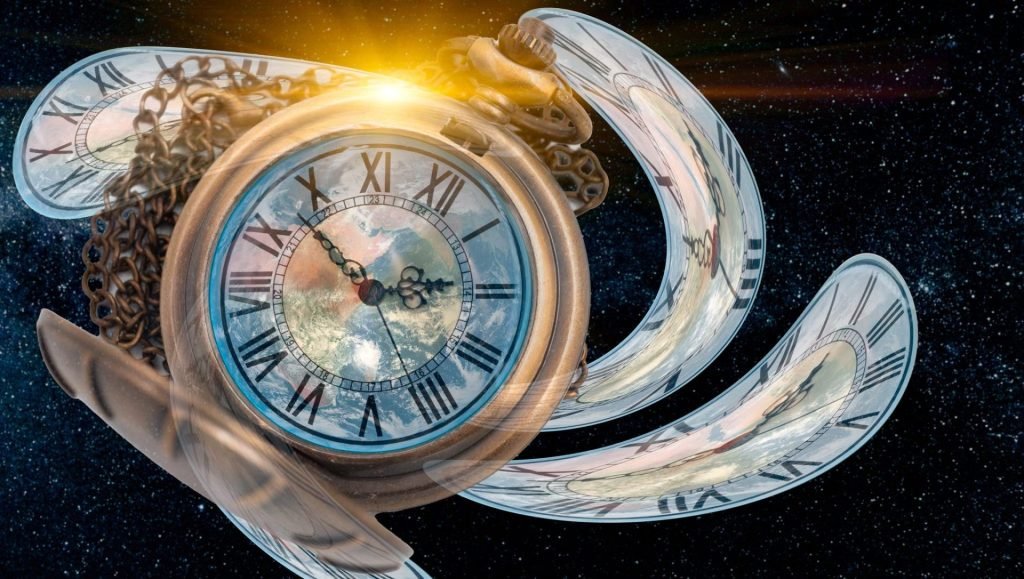
Getty Images
But it also makes the concept of time-traveling into alternate futures a reality.
Here’s what you’ll learn in this story:
- Time might actually have 3 dimensions.
- But it also means that the space would actually be one-dimensional, instead of the three dimensions we’re familiar with.
- This way of looking at the cosmos could explain the quirks of quantum mechanics, like a particle being in two places at once. It would even explain hypothetical faster-than-light particles.
What would the universe look like if you could travel faster than light? The answer may provide a surprising explanation to the mysteries of quantum mechanics.
Our universe plays by certain rules, which originate from different branches of physics. But sometimes the rules seem inconsistent with each other or don’t quite line up. And in other cases the rules seem to come out of nowhere, without clear explanation.
Albert Einstein’s special theory of relativity is one set of rules that helps us understand the universe. This theory tells us that time and space are linked together in a four-dimensional fabric, called space-time, with three dimensions of space and one of time. Time is special because we can only move in the direction of our future, unlike the spatial dimensions, where we are free to move wherever we like. Plus, special relativity tells us that movement in space-time is limited to no faster than the speed of light, over 186,000 miles per second.
Quantum mechanics, on the other hand, gives us rules about how subatomic systems work, those particles smaller than atoms. And those rules are very, very strange. For example, in quantum mechanics particles can seem to appear in multiple locations at once, and we are never exactly sure where a particle will end up. In fact, we’ve had to create an entire language called wave-particle duality to accommodate these rules. In this view, particles aren’t really particles. Instead they are waves of probability that slosh around. Where the waves peak, we have a good chance of finding the particle the next time we go looking for it. And where the waves are at their minimum, we are unlikely to see that particle.
These rules of quantum mechanics also allow for seemingly contradictory behavior like quantum entanglement, where one particle can influence another instantaneously—blowing well past the speed of light limit from special relativity.
In an effort to tackle these issues, researchers from the Universities of Warsaw and Oxford asked an altogether different kind of question in their 2022 paper. What would the universe be like if you could travel faster than light? Now in special relativity it’s impossible to move from below the speed of light and accelerate to reach it, let alone go faster than light. But the rules of special relativity also allow the reverse situation, where objects can start off faster than light already—but then they can never slow down below that limit.
According to the researchers, for observers who are already traveling faster than light, the connection between time and space is flipped. Instead of three spatial dimensions and one temporal dimension, faster than light observers see three dimensions of time and only a single dimension of space. This means that particles follow more than one trajectory at once. In effect, they travel into more than one future simultaneously.
From our normal slower-than-the-speed-of-light perspective, it looks like these faster-than-light objects are not behaving like particles at all. Instead, they act like waves. Think about it. If you throw a baseball it only follows one path. But if the baseball hits a nearby pond, the water waves travel in multiple directions at once.
Leave a Reply