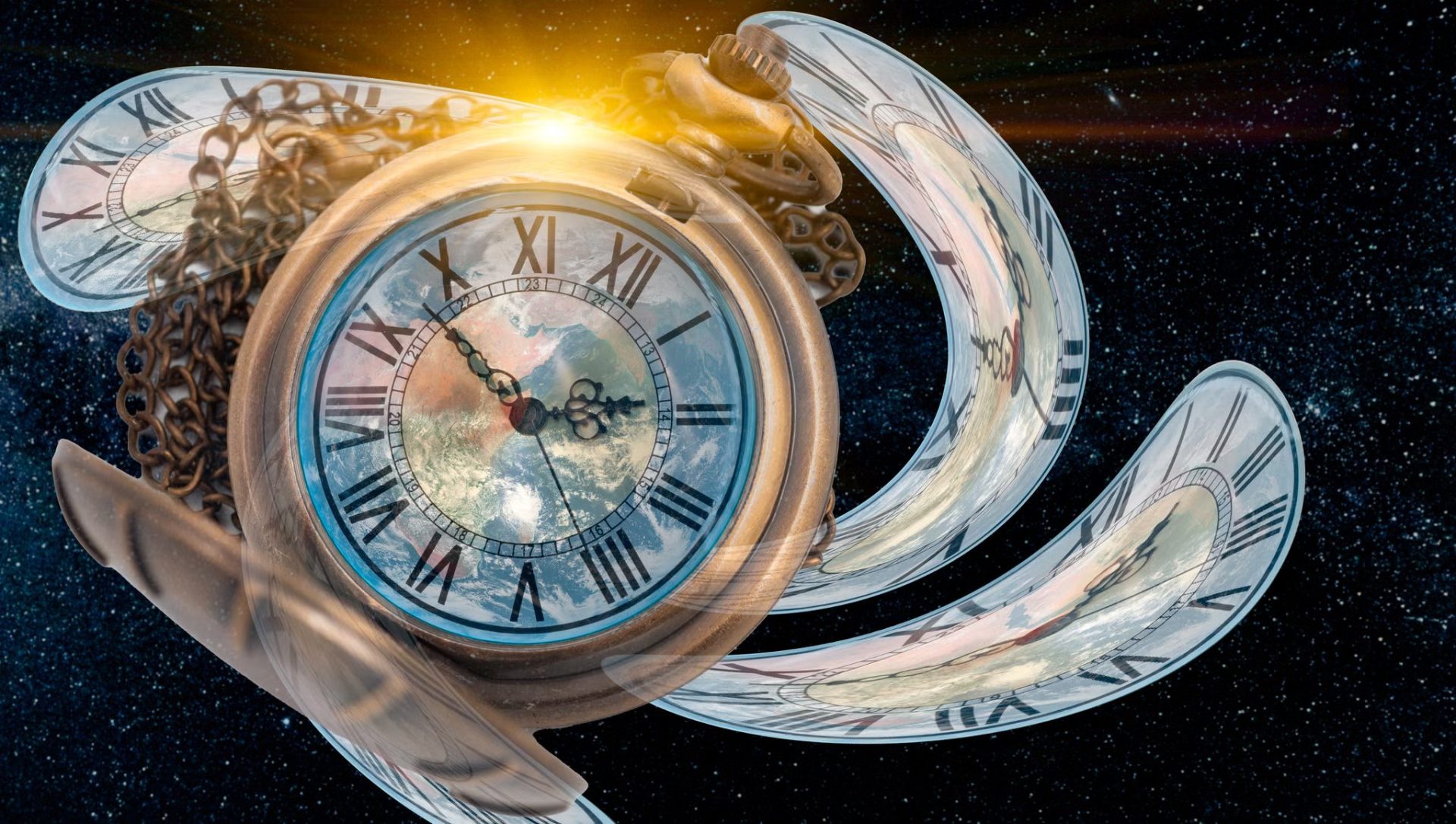

Ultraprecise atomic clocks could test the idea that time moves at multiple speeds.

Jose A. Bernat Bacete//Getty Images
Here’s what you’ll learn when you read this story:
- In Albert Einstein’s Special Theory of Relativity, the concept of “time dilation” illustrates that the flow of time is dependent on the velocity and position of the observer.
- In the quantum world, time has an even more counterintuitive behavior known as the “quantum twin paradox,” which describes how time can move both fast and slow in superposition.
- Using ultraprecise atomic clocks, along with technologies developed from trapped-ion quantum computing, scientists are getting close to experimentally testing the quantum realities of time itself.
To those of us living on Earth, time appears relatively immutable. Except for some clever bits of human intervention, one second inexorably ticks by after another in a never-ending march. But in the extreme worlds of general relativity and quantum theory, time is anything but constant.
In the early 20th century, Albert Einstein first demonstrated the concept of “time dilation”—where time flows differently based on the velocity and position of the observer—with his theory of special relativity. The most common example is that if you were to propel yourself near the speed of light, time (at least, from your perspective) would stop. While this is mind-bending enough as-is, quantum mechanics counters this oddity with a real “hold my beer” moment of its own. According to physicists, it’s theoretically possible for time itself to be in quantum superposition, meaning it can both flow quickly and slowly at the same time.
Leave a Reply