

In order to prepare for the journey, the first generation would have to spend 70-80 years in Antarctica.
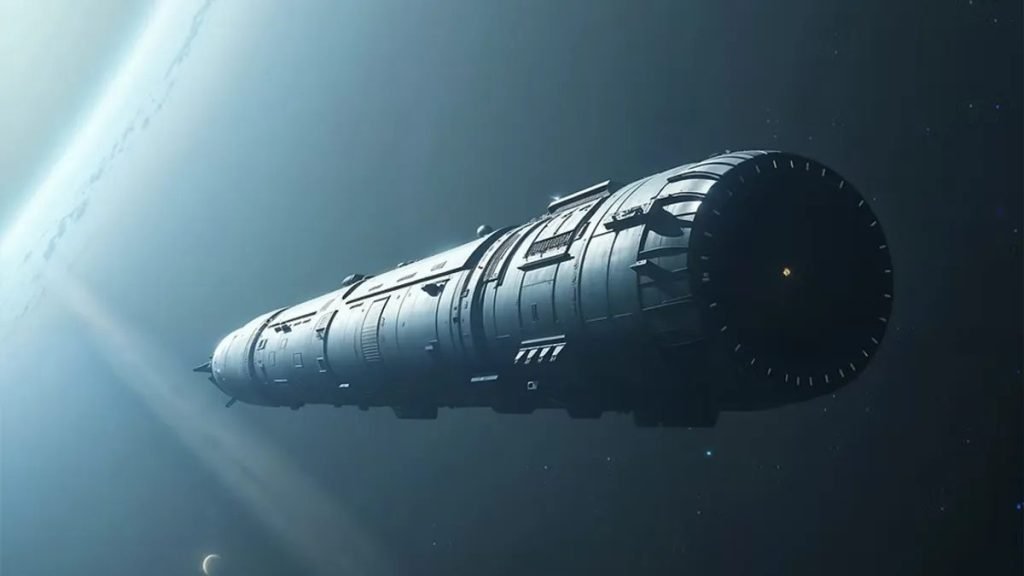
Could this ship take us to Alpha Centauri?
Image credit: Giacomo Infelise, Veronica Magli, Guido Sbrogio’, Nevenka Martinello, Federica Chiara Serpe, Project Hyperion
For beings of our size and lifespans, space is pretty big. So big, in fact, that to make it to our nearest star system you would need to factor in the fairly sizeable downside that you will die of old age before you get there.
Humanity has focused on making our spaceships more speedy, as well as the possibility of sending smaller, uncrewed lightweight ships to the system potentially within human lifespans. But if we want to send humans to the star system in the future (or go on other long-distance trips) we may have to accept that it will take several human lifespans to get there.
With the restraints placed upon them by physics, sci-fi writers have imagined “generational ships” for decades. The idea is pretty simple: creating a ship that will sustain a small society of humans for however many generations it takes to get to the intended destination. But in practical terms, such a mission would be pretty complex.
For a new competition exploring the practicalities of generational ships, dubbed Project Hyperion, scientists competed to design their own ship which could feasibly take humans to a hypothetical habitable planet at least 250 years away in terms of travel time. The winning team went one step further, designing a spaceship named “Chrysalis” which they propose could deliver thousands of people to Alpha Centauri, a trip taking over four centuries.
From the outside, the ship has a very simple design, looking like a giant tube. While other entries were more elaborate, the team chose this design to ensure safety for the occupants during acceleration at speeds up to 0.01 percent of the speed of light (c).
“A long cylindrical shape and geometry minimises the frontal section and MMOD shielding and reduces structural stresses during the linear acceleration and deceleration phases,” the team explains in their submission. “The majority of the spaceship mass is the liquid propellant for the [acceleration phase] and, to a lesser extent, the [deceleration phase], contained in the spaceships’ cylindrical tanks (mass sizing is presented in the next slide). The habitat module is contained in the inner core of the front module structure.”
Leave a Reply