
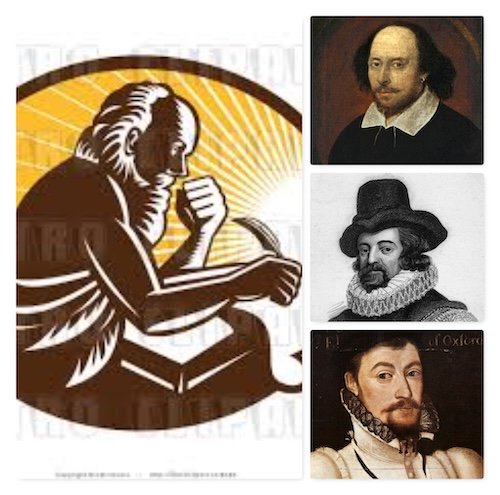
Much has been written about the possibility that William Shakespeare didn’t author the works credited to him, that he was, in effect, an impostor, or a “front” for accomplished writers of the era. Those making the case against Shakespeare argue that Shakespeare lacked education and was likely illiterate, noting that even his children and grandchildren were illiterate. When he died, there was no indication that he owned any books, notes, correspondence or copies of plays. There was much speculation that Sir Francis Bacon was the true author of the works of Shakespeare, but many others, including Christopher Marlowe and Edward de Vere, have been suspects. (photos, top to bottom: Shakespeare (1564-1616), Bacon (1561-1626), deVere (1550-1604)
Why would these contemporaries of Shakespeare need Shakespeare to “front” for them? The theory is that noblemen of that era were discouraged from involvement in the commercial stage. It was beneath the dignity of the elite class.
A recent segment of Expedition Files, hosted by Josh Gates, discussed this Shakespeare mystery and featured an interview with Dr. Roger Stritmatter, professor of humanities at Coppin State University, who seemed certain that de Vere was the true author of the Shakespeare works. This theory is said to have originated with J. Thomas Looney, an English school teacher, in 1920 and accepted by many.
In my blog of September 17, 2018, I wondered why not more consideration had not been given to the possibility that Shakespeare was an automatic-writing medium, much like Pearl Curran, who recorded the volumes of “Patience Worth” dictation (see my blog of November 2, 2025) Of course, the answer is that such a “woo-woo” theory is beyond the comprehension of mainstream academia and science. To even suggest it is to invite guffaws or scoffs. After viewing the recent TV program, I decided to see what AI (artificial intelligence) had to say about the authorship mystery. I began my asking AI (ChatGPT) what the consensus is now.
Leave a Reply