
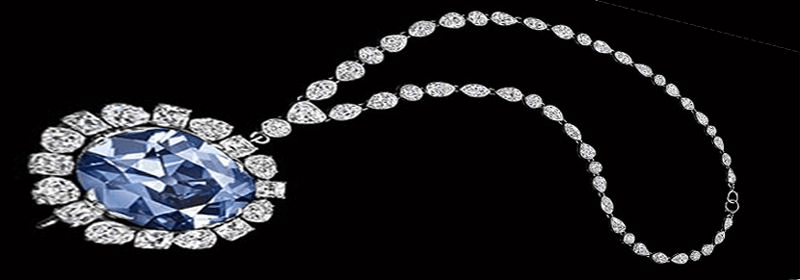
The Hope Diamond Today.
“You cradle the 45.5-carat stone—about the size of a walnut and heavier than its translucence makes it appear—turning it from side to side as the light flashes from its facets, knowing it’s the hardest natural material yet fearful of dropping it.”
— Associated Press reporter Ron Edmonds in 2003
The Hope Diamond, one of the most famous jewels in the world, has a history dating back almost four centuries. The beautiful 45.52-carat blue diamond is also said to be cursed, bringing misfortune and tragedy to its many owners over the years.

The jewel is believed to have originated in India, probably from the Kollur Mine in Golconda, sometime during the early 1600s. In 1630, French gem merchant Jean-Baptiste Tavernier began making a series of six voyages from France to Persia and India to trade in precious stones and other high-end wares. At some point between the years 1640 and 1667, he obtained a 115 carat (nearly the size of a man’s fist) precious stone that was somewhat triangular, crudely cut, and described by Tavernier as a “beautiful violet.” Though the merchant documented his travels and the gems that he collected over the years, he did not state from whom or when he obtained the large blue diamond that became known as the “Tavernier Blue.”
An early legend says that Tavernier stole the diamond from a Hindu temple, where it was set as one of two matching eyes of an idol. Afterward, the temple priests cursed anyone who might possess the missing stone.
Tavernier returned to Paris on his final voyage in 1668 and, the same year, sold the large blue diamond to French King Louis XIV, along with 14 other large diamonds and several smaller ones. His final voyages secured for him a large fortune and a great reputation at home. In 1669, he received patents of nobility, and the following year, he purchased a large estate near Geneva, Switzerland, and spent his next years writing and publishing accounts of his journeys. In the end, if the diamond was cursed, it did not seem to affect Tavernier, who lived a comfortable life until his death at the age of 84.
In the meantime, King Louis XIV commissioned the court jeweler Jean Pitau to recut the Tavernier Blue to “make him a piece to remember” in 1673. The large blue diamond was then cut almost in half, resulting in a 69-carat stone. The royal inventories described its color as an intense steely blue, and the stone became known as the “Blue Diamond of the Crown,” or the “French Blue.” Pitau spent two years on the piece, resulting in a “triangular-shaped 69-carat gem the size of a pigeon’s egg that took the breath away as it snared the light, reflecting it in bluish-grey rays.” When complete, the diamond was set in a gold cravat pin that received additional support from a ribbon worn around the neck, which the king wore on ceremonial occasions.
Leave a Reply