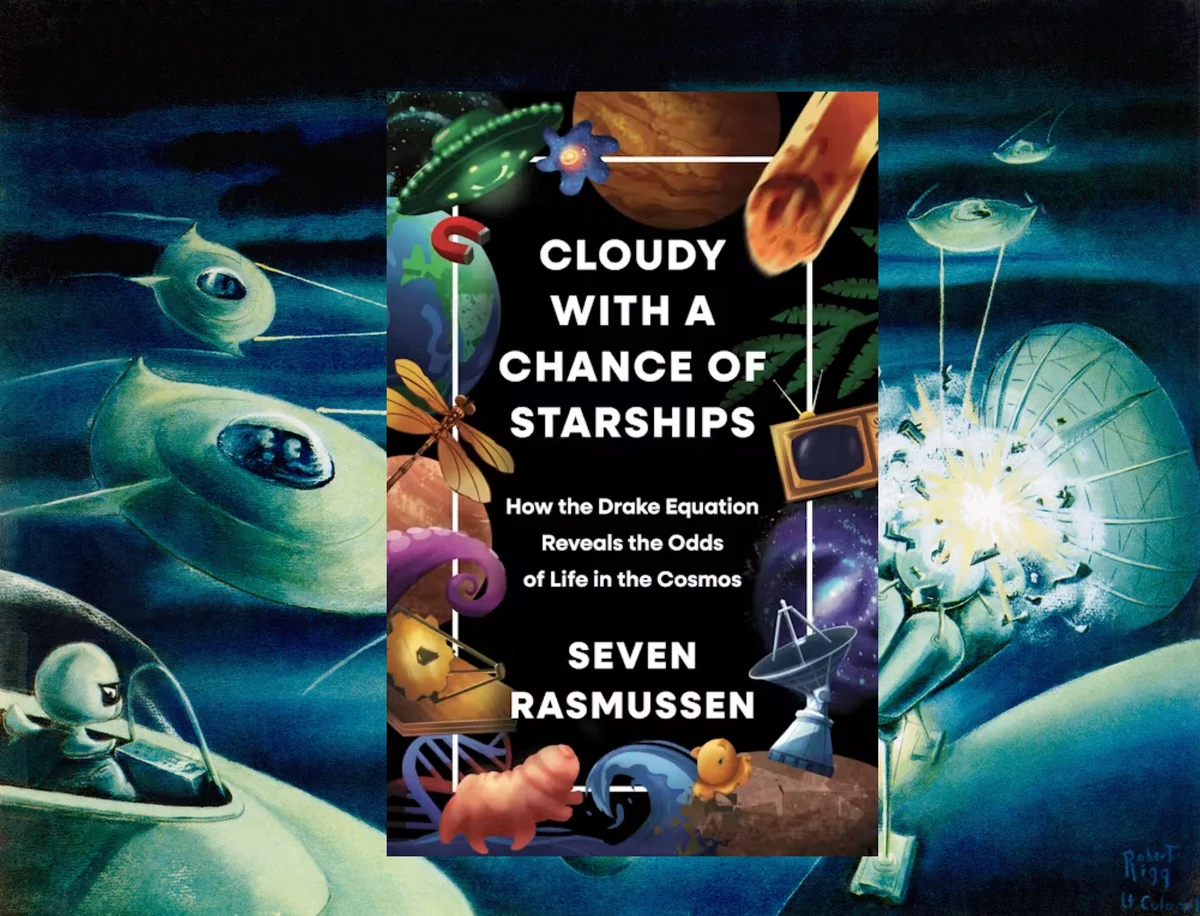

Seven Rasmussen, an astrobiologist and author of the new book Cloudy with a Chance of Starships, gives readers a tour of the astonishing science behind modern searches for alien life.
We’ve been looking for aliens for as long as we’ve been looking up at the starry night sky. Wondering, “What’s up there?” quickly leads to asking, “Who’s up there—and why won’t they come down here and say hi?!”
Astrobiology—the study of life in the universe, from how it began and evolved to how it might take shape elsewhere—is the catch-all scientific field in which researchers grapple with such weighty questions about what’s out there. And, at least when we contemplate the existence of little green men rather than little green microbes, one of astrobiology’s cornerstones is the Drake equation, a seven-factor formula devised by astronomer Frank Drake in 1961 that estimates whether extraterrestrial civilizations are vanishingly rare—or common as dirt.
In the new book Cloudy with a Chance of Starships, Seven Rasmussen, an astrobiologist and devoted Star Trek fan, acts as a tour guide to the astrocurious, showcasing how the Drake equation is more than the sum of its parts—it’s not just a tool for quantifying our chances of first contact but also a tracker of astrobiology’s ever changing frontiers.
Read More – Where are all the aliens? A new book explores possible answers
Leave a Reply