
His job was to uncover secrets from the unknown. But his curiosity opened doors that the government preferred to keep closed.
This story is a collaboration with Biography.com.
Do you think the U.S. government is hiding, and possibly reverse-engineering, extraterrestrial technology? Think again. Or better yet, don’t think about it at all. Nothing to see here.
That’s the underlying message of a report released in 2024 by the Department of Defense. The 63-page “Report on the Historical Record of U.S. Government Involvement with Unidentified Anomalous Phenomena (UAP)” concludes that the DoD’s All-Domain Anomaly Resolution Office (AARO) “found no evidence that any [U.S. Government] investigation, academic-sponsored research, or official review panel has confirmed that any sighting of a UAP represented extraterrestrial technology.”
The AARO, as The Guardian summarizes, is “a government office established in 2022 to detect and, as necessary, mitigate threats including ‘anomalous, unidentified space, airborne, submerged and transmedium objects’.”
This report came on the heels of, and in contradiction to, what was arguably the most high-profile hearing on UAPs—formerly known as unidentified flying objects, or UFOs—in decades: the August 2023 testimony of “whistleblower” Dave Grusch.
In the bombshell hearing, Grusch, a former member of the Pentagon’s UAP Task Force, claimed that he had been made aware of a “multi-decade UAP crash retrieval and reverse engineering program.” But his claims were never substantiated, and while the 2024 report doesn’t mention Grusch by name, it does offer plausible explanations for the phenomena he described in his testimony.
This is hardly the first government report to debunk stories about little green men and their strange flying saucers. So, why do Americans keep clinging to conspiracy theories about extraterrestrial visitors? Blame science fiction, the AARO report says:
“A consistent theme in popular culture involves a particularly persistent narrative that the USG—or a secretive organization within it—recovered several off-world spacecraft and extraterrestrial biological remains, that it operates a program or programs to reverse engineer the recovered technology, and that it has conspired since the 1940s to keep this effort hidden from the United States Congress and the American public.
AARO recognizes that many people sincerely hold versions of these beliefs which are based on their perception of past experiences, the experiences of others whom they trust, or media and online outlets they believe to be sources of credible and verifiable information. The proliferation of television programs, books, movies, and the vast amount of internet and social media content centered on UAP-related topics most likely has influenced the public conversation on this topic, and reinforced these beliefs within some sections of the population.”
The X-Files and the internet helped guide curious people toward the fringes of ufology. But to fully understand the ongoing public skepticism regarding the government-provided explanations about aliens, we must consider the man who was once responsible for upholding these “official” stories—and examine his stunning evolution from a fellow skeptic to the world’s leading UFO advocate.
Who Was J. Allen Hynek?
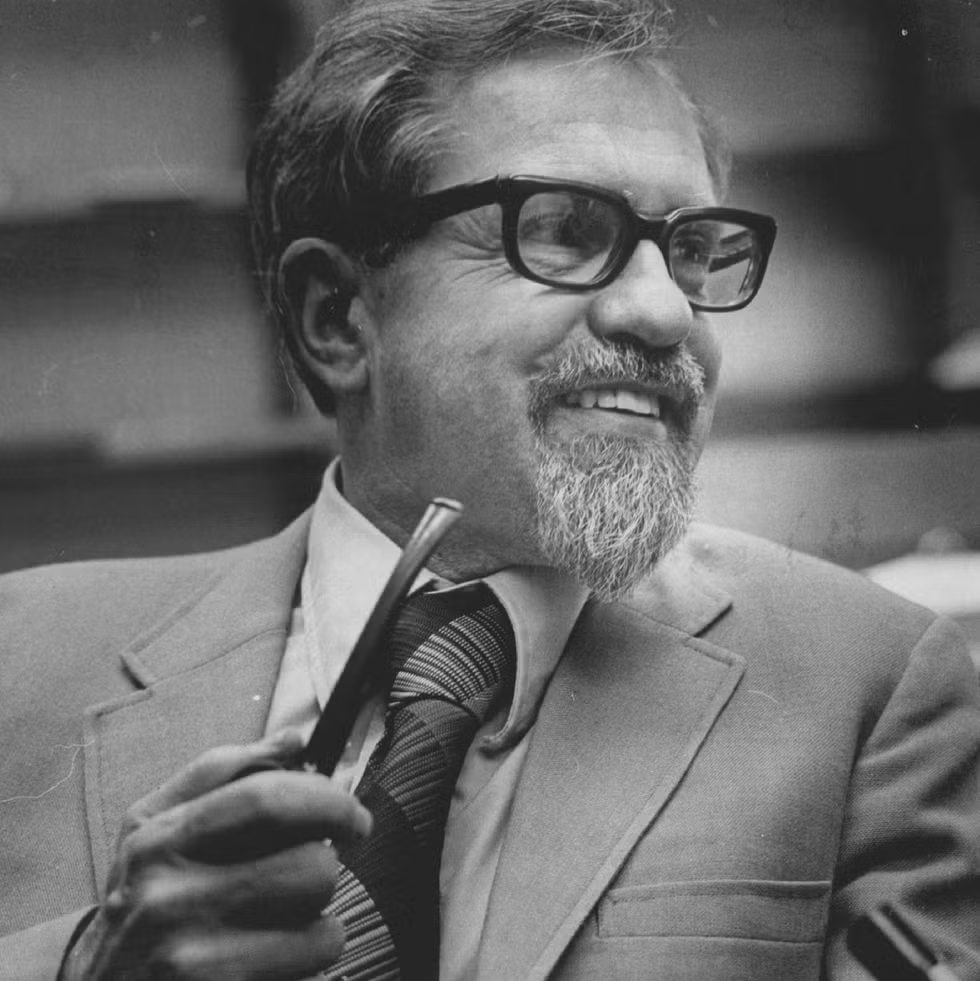
Denver Post//Getty Images
J. Allen Hynek, photographed in 1972.
Josef Allen Hynek, who was born on May 1, 1910, developed an interest in the cosmos following an episode of illness during his childhood. The sickness steered his curiosity away from following in the footsteps of his mother and father—a schoolteacher and cigar manufacturer, respectively—and toward the universe. Biography.com writes:
“An introduction to the stars came after Hynek was bedridden with scarlet fever at age seven: Having run through their supply of children’s books to read, his mom turned to textbooks, with a high school edition on astronomy capturing the boy’s attention.”
From an early age, Hynek’s passion for science was mixed with a penchant for mystery and a pursuit of philosophical thought. He had “an interest in more esoteric subjects, particularly the works of the Rosicrucian secret societies and hermetic philosopher Rudolf Steiner,” according to Biography.com.
In 1934, as a doctoral student, Hynek contributed to observations of the Nova Herculis supernova at Perkins Observatory in Ohio. By 1936, he joined Ohio State University’s Physics and Astronomy Department. His research over the next 12 years culminated in his appointment as director of the university’s McMillin Observatory.
And that’s when the U.S. government came calling—with an unusual request.
Leave a Reply